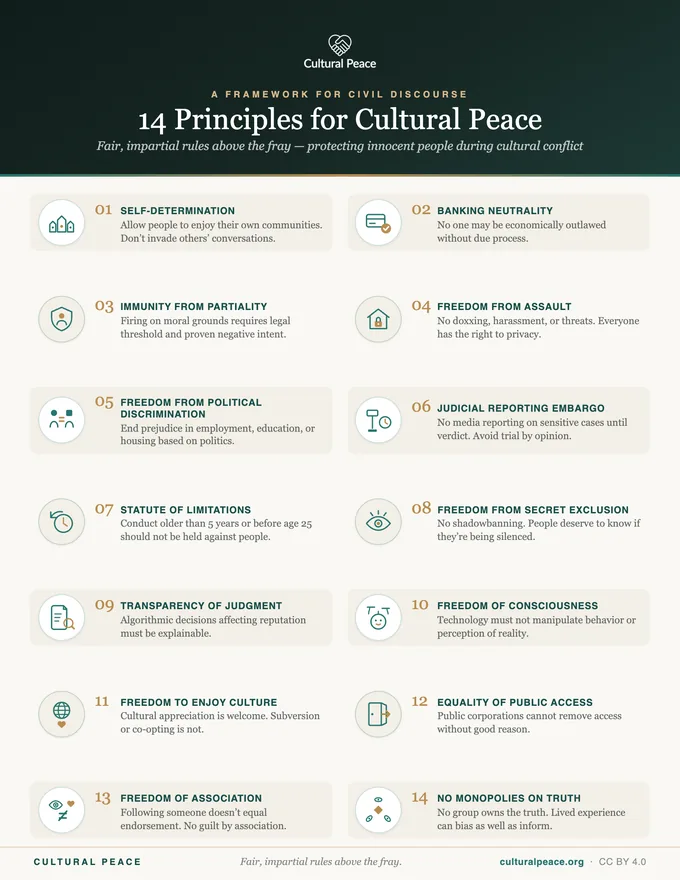
Principle 01Self-Determination & Political Franchise
Allow people to enjoy their own communities with their own subcultures. Don’t stop or invade other people’s conversations.
People need their own spaces. Shared identity needs room to become culture — and culture needs some degree of separation to survive. Groups make it easier to coordinate, to build trust, and to sustain norms that would be washed away in the mainstream.
Respect is not synonymous with inclusion. Think of an evening out with family, an evening out with friends, people you feel comfortable with. Part of the pleasure is the selectivity: you are with your people. Of necessity, this pleasure appears exclusive from the outside, but forcing you to add someone new in the name of inclusivity ruins the moment.
Some pleasures demand exclusivity. Respect doesn’t mean erasing differences. Respect means being aware of differences and affording others the dignity and self-determination we give ourselves. Sometimes that may mean being excluded.
Christopher Robinson
Let people have their own spaces. Don't petition for private conversations to be shut down just because you dislike a non-violent ideology or what's being said — unless someone is actually breaking the law.
Different groups talk differently. A conversation that’s normal inside one community can look alarming to someone passing through from another. But you don’t get to impose your norms on someone else’s space, or judge a snippet by standards its speakers never agreed to.
Don’t judge people by who they follow. Retweeting someone isn’t endorsing their character — some people curate a broad set of inputs, or respect someone’s professional work without sharing their values.
A group should not be judged by its worst members, unless the larger group is explicitly shown to approve of their actions. Works featuring challenging material from a historical perspective should not be excised, particularly if the context is within education. Large tech companies are censoring or down-throttling information they consider dangerous, without transparency about what they’ve suppressed or how research is cherry-picked. On-device content moderation may soon mean that a link sent directly by a friend gets disappeared before it reaches you.
Who are they to say what knowledge is safe? Once a platform begins censoring one category of speech ‘for the common good,’ the slope steepens fast — toward suppressing almost anything controversial or objectionable to someone, somewhere. This doesn't just prevent subcultures and minority beliefs from coalescing — it stifles whistleblowing, and it kills new ideas, which begin as heresies before the mainstream accepts them.
Public spaces — schools, hospitals, campuses, and especially those taking public funding — should remain an impartial commons. Online platforms must be held to the same standard: they have an effective monopoly on shaping opinion, and banning political parties or politicians from them is an act of extraordinary power that demands extraordinary justification.
Peace means letting people form their own communities, with their own rules, without needing permission.
Principle 02Banking Neutrality
End the removal of economic franchise. No-one may be ‘outlawed’ without due process.
Modern life runs on digital payments. Lose access to the payments network and you can't pay rent, buy groceries, or get paid for honest work.
Payment processors have immense power — they can strongarm other players into compliance by threatening to cut access. And they're already kicking people off their platforms despite no breach of law — sometimes to appease authoritarian governments, with little opportunity for appeal. This can cost people their entire livelihoods, creating a terrifyingly uncertain future. Credit scoring mechanisms can lock honest people out of bank accounts by paradoxical rules — and those systems are spreading into business too.
[If FAMGA dropped off the face of the Earth], nearly all of your electronic devices would either stop working or would disappear, the internet would become nothing short of mass chaos, nearly all e-commerce activity would halt, and your undying thirst to watch cat videos would forever go unquenched.
Matt Hulbert
Evidence is mounting that companies are changing prices and credit availability for certain users through opaque algorithms — sometimes without any human decision behind them. And because these platforms are near-monopolies, the alternative would mean building an entire parallel internet. Our payment networks must be scrupulously non-partisan if we are to build a fair society.
Democratic franchise is important, but economic franchise is essential. We cannot allow people to be outlawed from the economy simply because they are deemed politically undesirable. Just as many nations separated church from state, we must separate money from ideology.
Banking neutrality is essential — especially as social media companies become de facto megabanks, and the biggest entities consolidate further. Banning policies are capricious and unexplained. Losing access could mean absolute economic disenfranchisement.
If people cannot hold bank accounts or credit cards, if they are refused service on account of their political beliefs, you back them into a corner. They have nothing left to lose, and all options become permissible simply to survive and take care of their families. Participation in the economy is a right, not a privilege.
Peace requires that nobody is locked out of the economy for what they believe.
Principle 03Immunity from Partiality
Termination of employment on ‘moral grounds’ must meet the threshold of being legally prosecutable or indictable, and must show clear negative intent.
What counts as moral is changing fast, and it already differs sharply between groups. As polarization deepens, the gap between competing moral norms will only widen. Give people the benefit of the doubt unless they were clearly acting in bad faith.
We must refuse to attack the livelihoods of people we disagree with. Tit-for-tat economic violence makes paupers of us all. The tactic of pressuring someone's employer to fire them doesn't end a conflict — it metastasizes a small one into a much larger one.
To attack a person’s livelihood is to attack their spouse and dependents, innocent parties. We must tolerate those we disagree with — confront their arguments, but leave the person, their family, and their livelihood intact — unless they have been justly prosecuted in a court of law.
Employers should commit not to dismiss people on subjective, non-judicial ‘moral’ grounds under pressure from a mob. When employers buckle, the public should hold them accountable for failing to protect their own people.
Peace requires enabling people to build a secure career on the foundation of honest work.
Principle 04Freedom from Assault
Personal attacks including doxxing, harassment, and threats to people’s families are unacceptable. Everyone has a right to privacy, and a private life.
Everyone is watching. Everything is recorded. A moment’s confrontation can reach millions before you walk away from it.
Social media turns private people into public figures overnight, with the constant danger of being doxxed and the implied threat that leaked personal information carries.
I object to violence as the good it does is only temporary. The evil it does is permanent.
Mahatma Gandhi
Cultural conflict is following people offline. Political violence has become a normal way to keep opposition out of the running. Private family lives are being invaded — people hounded during everyday activities, property attacked by mobs and arsonists, altercations growing more violent. Sooner or later, an incident goes too far — and someone is killed.
Peace requires respecting personal space and privacy — especially for those whose views you profoundly disagree with.
Principle 05Freedom from Political Discrimination
End prejudice in employment, education, and housing — including on the basis of political affiliation.
Industries are very strongly segregated by political affiliation. This means it can be extremely difficult to enter or maintain a career in a certain sector if one’s political alignment does not fit. Over time, this effect tends to increase further, as minorities will leave, and thus the predominant ideologies concentrate. Left unchecked, this becomes a soft caste system — people locked out of entire careers by default.
Academia is one of the most polarized sectors — some departments show a 100:1 ratio. The humanities are often institutionally prejudiced against anyone outside postmodernist values, reinforcing structural inequities by locking out the very people who most need access to higher education.
If one group in society is frustrated by feeling unwelcome, or even heretical, within an academic environment, this will inevitably create immense resentment. No surprise, then, that people who are less likely to be welcome in such an environment trust experts less than ever.
When science comes from a monoculture, public trust in it weakens. Partisan bias and a preference for political correctness over accuracy feed anti-intellectualism — and the people who suffer most are those who need the public to trust science.
Political affiliation already makes it harder to access housing, education, and employment in certain areas — locking people out of a city’s cultural core and off the property ladder. Most industrialized nations forbid discrimination based on protected characteristics. It may be time for political orientation to become one.
Peace requires equal access to the pillars on which a successful life is built.
Principle 06Judicial Reporting Embargo
Court cases for alleged crimes of a sexual nature, or alleged crimes which are heavily politicised, should not be reported upon until a verdict is reached.
People will always be clumsy about attraction — it's part of being human. Unless someone is a genuine threat, is stalking, or won't take no for an answer, a polite rebuff is enough. It's unjust to destroy someone for an awkward pass. Don't weaponize ideology against normal human behavior.
No one should be judged in the court of public opinion — and no juror today can realistically avoid it.
The justice system works until a case is politicized and tried in the media — and it’s not built to survive that. Journalists increasingly act as activists rather than reporters. Hearsay should never convict someone in public opinion. These cases become ‘scissor issues’ that rupture society further, as two indignant camps dig in.
Avoiding the news used to mean skipping the newspaper. Today, news is inescapable — and even lawyers representing defendants are being targeted for career or domestic destruction simply for doing their job.
Media reporting of sensitive cases before a verdict is reached damages justice, and it damages innocent people. Judges should consider embargoing coverage until judgment. If further litigants are moved to come forward, they may do so after the first matter is decided. We must thoughtfully weigh this against society’s need to enable large groups of plaintiffs to collectively pursue legal action against those who may have committed widespread offenses, even if they were never formally charged.
Destroying someone’s reputation in public is itself a form of violence — and hysteria over hard cases can lead to real people getting hurt. This is especially troubling when police themselves are policing ‘non-crime crime’. Many sensitive matters are now decided in private hearings — often within academia — rather than in courts. If a private hearing is to serve justice, it must be genuine: due attention, sufficient information for the defense, no surprise charges. And the accused must retain the right to take the matter to a court of law.
Fabricated or overinflated claims must be prosecuted seriously. The real victim of a hate crime is society at large — its trust. For the same reason, the false reporting of a hate crime is itself a hate crime: it destroys the social trust that holds us together, regardless of whether a specific individual was named. Bad-faith hoaxes should be legislated against as a public order offense.
Peace requires impartial justice, adjudicated by a court of unbiased peers.
Principle 07Statute of Limitations
Cultural expectations and rules are changing rapidly. Conduct, jokes, writings, etc older than five years, or made before the age of 25, are not to be counted against someone, unless the matter has been judged in court.
We've all said things we'd take back. The difference now is that everything is written down forever. Today, now that so much of our private thought lives in digital form, we inhabit a virtual panopticon. The practice of using ‘Offence Archaeology’ or ‘Opinion Necromancy’ to dig up dirt on people has become trivially easy.
Media should be thought of like a time machine; it can take us back to the time and culture in which it was written. But we are the visitor to that realm. We are the stranger. Media, and the statements of its creators within, should be judged in the context in which it was made.
The past is a foreign country; they do things differently there.
L.P. Hartley, The Go-Between
We should have faith — in others and in ourselves — that people can and do change. Awareness deepens over time. Beliefs sharpen. Errors of judgment are a necessary part of growing wiser. Acknowledging human flaws — and that most people are trying to act in good faith, even when they stumble — invites forgiveness. If we believe in progress, we must allow people time to catch up with it.
Peace requires forgiveness — and the faith that people can grow.
Principle 08Freedom from Secret Exclusion
No one should be left wondering whether they can express themselves in a way that is meaningful for them. ‘Shadowbanning’ people is unacceptable.
Posting something and hearing nothing back is eerie. One suspects that one has been shadowbanned so that no-one else sees that content, or its distribution is throttled (de-boosted).
Those whom the gods wish to destroy, they first make mad.
Henry Wadsworth Longfellow
You don’t have to lie to people to manipulate them. A true story can carry different meanings depending on how it’s told. Websites can be de-listed by search engines, making content invisible, or services withheld in non-neutral ways. The rules are often arbitrary and unexplained. Even code deemed ‘hateful’ can be disappeared overnight. Meanwhile, technologies that automatically track ethnicity, sexuality, and personality are enabling different treatment — quietly.
AI — particularly generative AI — will amplify this by enabling plausible deniability. ‘Glitches,’ ‘goofs,’ administrative ‘errors’ that just happen to silence certain voices. Not being able to prove whether it was deliberate is maddening and Kafkaesque — and may render people ineffective through sheer frustration.
Any policing of content — by human or algorithm — must be explicit, accountable, and justified. Freedom of Reach must not be weakened to curtail Freedom of Speech. There must be no secret wall between two people who don’t know it’s there. Choosing your own filters is fine. Being forced into a virtual ghetto with glass walls is not good faith.
Peace requires respecting others enough not to play cruel games with them, or to ostracise them through deceit.
Principle 09Transparency of Judgment
The specific reasoning behind decisions or predictions that affect the capabilities or reputation of people and organizations must be accessible, transparent, and explainable in plain language.
Algorithms are making snap judgments of people’s content and character, without explaining why, and without any recourse to demand a detailed description, or challenge false impressions. We cannot allow extrajudicial judgment to become accepted practice in our society.
Blacklisting of prospective or former employees for prejudicial reasons is a major issue affecting many sectors of employment. This is becoming an even more pressing issue due to algorithmic processing of data, as well as widespread political polarization and cancel culture.
Blacklists should be strongly discouraged. Where they exist, they must be transparent. The same goes for employment references and performance records shared with third parties. Without explicit coverage under employment law, a massive loophole enables quiet exploitation of people who fall outside its protections.
Online tools now rank potential hires by the sentiment of their comments — even posts they've merely liked or favorited. These tools offer no explanation for how the score is calculated, what data drove it, or what it should mean.
This launders bigotry through the backdoor — wash your hands of explicit discrimination while ensuring only the ‘right sort’ pass through the gate. Algorithms and the people who deploy them must be held accountable. Any system that can affect reputation, resources, or livelihood must be fully transparent.
Peace requires that algorithms not be used to launder secret, prejudicial acts.
Principle 10Freedom of Consciousness
Technology must not be used to manipulate people’s behavior or impressions of reality. Our minds are sacred sovereign territory.
Propaganda used to be one-size-fits-all. Today it can be micro-targeted — calibrated to you specifically, repeated in barely noticeable impressions that shift not just your opinions but your mood.
Technology already enables uncanny predictions about people's behavior. As it improves, our minds will be invaded more deeply — not just by advertisers, but by educators and employers.
There's a war on for our minds, not just our loyalties. The human mind cannot become a battlefield — or a testing ground for the worst excesses of psychological manipulation. No non-obvious fake accounts or generated misinformation can be permitted to twist our very perception of reality. The human mind is off limits.
Peace requires respecting the sovereignty of the heart and mind.
Principle 11Freedom to Enjoy Culture
Culture and cultural tropes should be open to appreciation by others, as long as they are treated with respect.
Every authoritarian project starts by claiming culture — rewriting its history, co-opting its symbols, deciding who may participate in it.
Divide and conquer is a time-tested tactic, and it applies to culture too. Forking a culture — steering it toward a political or ideological aim — is an old ploy. That's why people are rightfully alarmed when they sense their culture being subverted, erased, or replaced.
Homage is not theft. Satire is not attack. And good-natured clumsiness deserves a gentle correction, not a public shaming.
Our love of our (pop) culture is a non-threatening bridge not politicized, a bridge that links people of every political stripe, a line of communication between all camps.
‘Overlord DVD’
However, the subversion or co-opting of a culture is unacceptable. Taking a culture and rewriting it — violating its traditions, disrupting its canon, changing its character and values — is cultural appropriation.
Peace requires that we don't rewrite other people's cultures — and that we don't lock them out of enjoying ours, either.
Principle 12Equality of Public Access
People should not be excluded from public communities or denied the services of public corporations without good reason.
Researchers reverse-engineering YouTube’s algorithms, evidence is emerging that it may be demonetizing content based on simple keywords. Anything with a title or description featuring words as innocuous as ‘Gay/Lesbian’ to ‘North Carolina’, or even ‘Asians’ may be liable to be blocked from advertising revenue.
Furthermore, tactics such as alleging copyright infringement may be used to suppress unfavorable news, hold people to digital ransom, or appropriation of revenue. Online flash mobs may even cause content to be demonetised simply for commenting on it. This can lead to the deletion of associated email accounts, along with the channel, greatly amplifying the economic and social damage, and amplifying the chilling effects.
Demonetizing content to silence voices you disagree with, placing surcharges on certain consumers, or kicking people off platforms for ‘lack of commercial viability’ based on their politics — these are forms of economic censorship, however they’re justified.
Individual boycotts are a right. Corporate boycotts — a business refusing service without good reason — are not. Mob-level pressure campaigns that force security costs, threaten economic damage, or coerce local governments into cutting ties with a third party are not boycotts. They're closer to making someone an economic outlaw.
If a business is an effective monopoly or part of a cartel (i.e. it’s practically impossible for the average person to avoid it, or that avoiding it would inflict a large penalty in terms of resources such as money or time) then it shouldn’t be allowed to discriminate based on ethnicity, age, or political or sexual orientation, or sector of employment.
There's a real difference between a private club and a public platform. If you're publicly traded, open to everyone, and built on the commons, you don't get to pick and choose who you serve. Private clubs, membership organizations, and one-on-one contracts happen on private terms — that’s why they can set their own membership criteria, just as you can choose who enters your home. But if a business is open to the general public and relies on public custom, the social contract that gives it those privileges also gives it duties. It cannot be partisan or discriminatory.
When people feel cheated out of a fair life, they lose hope — for themselves and their children — and what grows in its place is frustration, resentment, and desperation. Economic gatekeepers must not use their power to support partisan interests. Boycotts belong at the individual level, as personal acts of conscience, not at corporate or jurisdictional scale.
Peace requires that we enable everyone to participate fairly in public communities and to benefit from public corporations.
Principle 13Freedom of Association
Association with a person or group, following them, or acknowledging their content should not be equated to agreement or endorsement. Contamination by proxy is unjust and invalid.
Curious people read widely — including things they disagree with. Even a wrong idea can hold a grain of truth, or an angle no one else considered. A bad idea can still be a jumping-off point toward a better one.
In a with-us-or-against-us climate, there's a growing tendency to police other people's attention — to root out signs of dissent. Online, where who has viewed or liked what is transparent, this becomes surveillance.
There are a hundred reasons to bookmark something, and "full agreement" is only one of them. A like may signal nothing more than ‘I hear what you’re saying’. Is someone ‘angry’ at an incident itself, or the way that someone talked about it?
Norms shift by platform and over time. A Twitter ‘heart’ was once a ‘favorite’ — a neutral bookmark. Old favorites have been weaponized to smear people as ‘loving’ objectionable views. That’s an error of judgment, but policing someone’s personal curation is an error of morals.
Peace means trusting people to listen, weigh, and make up their own minds.
Principle 14There Are No Monopolies on Truth
No person, identity, or group has a natural monopoly on the truth of a situation. On the contrary, lived experience within a cultural tribe may be reason to take someone’s assertions with a grain of salt.
There’s a common idea that lived experience should be the last word — that the person closest to a situation gets to define it.
But objective truth is difficult to discern, and proximity to a situation often makes impartiality harder, not easier.
People with identity at stake deserve more credence for their experience — and more scrutiny of their conclusions, because the risk of motivated reasoning is higher for everyone who has something to lose or gain.
That's a genuine tension — and it doesn't resolve through assertion. It resolves through dialogue: between people who live inside a situation and people who can see it from outside. Neither view alone gets close enough to the truth.
People in a particular demographic may feel their experience speaks for the whole group. It rarely does. Opinions and experiences are personal — they don't entitle you to speak for others.
Peace requires accepting that no one owns the truth of a situation — and that the closest thing to it emerges from honest dialogue between those who live inside it and those who can see it from outside.